Posts

Showing posts with the label Mentoring

But Wait, There's More...

Image
Tim Shaw became the face of Demtel International and popularised the saying, "But wait, there's more...," for the Australian TV viewing audience. In recent posts I have described my experience with Discovery Bible Study groups and have encouraged others to start a discovery group. But wait there's more! Discovery Bible Study is one tool, or strategic action, in a whole disciple-making or church planting movement.The disciple-maker is open to meeting God-prepared people, people who are seeking and hungry for the gospel or people who have already received  Christ as their Saviour and want to learn how to share the gospel. Discovery Bible Study, with it's obedience-based  methodology, becomes the instrument for reproducing disciples, who reproduce other disciples. "Whoever has my commands and keeps them is the one who loves me. The one who loves me will be loved by my Father, and I too will love them and show myself to them." John 14:21 NIV Again a quick se...

Pop-Up Discovery Groups...

Image
Pop-up food venues have become popular. Food trucks and stalls are popping up, and down, all year round. Food vendors congregate, set up tables and chairs, and in no time people arrive to whet their appetite and enjoy conversation with like-minded others. Sharing food is so often conducive to meaningful conversations. Food addresses our physical hunger and eating with others can satisfy our social needs. Important as these experiences are to our wellbeing Discovery Bible Study groups go beyond that to address our deeper spiritual needs. Jesus answered, “It is written: ‘Man shall not live on bread alone, but on every word that comes from the mouth of God.’  ” Matthew 4:4 NIV People, who are searching and spiritually hungry, come together to feed on the Word of God in a Discovery group. They encourage one another and seek answers to the question, "Having read this passage how then shall I live?" They are open to the Spirit of God and are prepared to step out in obedience when t...

Bromeliads Part 2...

Image
In an earlier post, January 2014, I mentioned that I had transplanted several pups from a bromeliad that my brother had given me. But, alas, I have to report the transplants failed! I reported my failure to my brother an d he explained that the pups I had cut off were too small. Fortunately another pup appeared, so I left it attached to the original plant until it had grown larger before cutting it off and transplanting. The good news is that it has taken and is happily growing in its new pot. While the original bromeliad, given by my brother, has continued to produce pups, those I cut off too early withered and died, and the pup I left attached longer has not only survived but thrived. Again my experience with the bromeliad reminded me of the Parable of the Sower told by Jesus in Matthew 13. Jesus wants to reproduce disciples many times over across the nations. We need to be about the business of sowing the Good News of Jesus so that God can produce the harvest. However, there will be...

Fred Hollows

When respect for the dignity of human beings is omitted from medical assessment, medicine ceases to become a science and is in danger of becoming a set of formulas, as arid and unhelpful as spells, curses and other hocus-pocus. Fred Hollows, Updated Autobiography with Peter Corris This statement struck a cord with me and I recalled another statement by Hans Eisen and Bernard Mulraney in their survey, Impediments to the Adoption of Modern Quality Management Practices (in Australian Manufacturing Industry) Monash University, 1992, “…an attitudinal change is required for success. This should begin with a reappraisal of the intrinsic worth of the individual at all levels.” Fred’s work while identifying the urgent need for appropriate Vitamin A capsules to address deficiencies also calls for a better understanding of how people in the affected societies live. He recalls getting into an argument with a researcher who gained a considerable reputation by showing the dramatic improvement in...

The Dish

Image
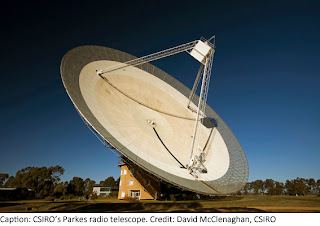
The Dish , starring Sam Neill, featured the radio telescope at Parkes, NSW. The telescope played a major role in the Apollo 11 mission to place a man on the moon. Cliff (Sam Neill) and Glenn (Tom Long) were out on the dish after locking on to the signal once again after loosing all the data following a power supply failure. Cliff: Imagine stuffing it up. Glenn: How come you’ve changed? Cliff: My wife told me, “Failure is not quite so frightening as regret.” Glenn: That’s good advice. I wish someone had told me that.

Jessica

Jessica , an Australian TV mini-series, is based on the novel, with the same name, written by Bryce Courtney. Jessica Bergman, played by Leeanna Watsman, had been committed to a mental asylum by her mother. Wandering the grounds of the asylum with her barrister, Mr Runche, played by Sam Neill, who is down and out and often inebriated, Jessica explores the possibility of regaining custody of her young son. Coming to the realisation that it will be next to impossible given her circumstances she turns to Runche and looking at him she apologises, “I’ve wasted your time.” Runche replies, “You can’t waste my time. It belongs to me and if I choose to use it on your behalf I will do so.” Runche’s pithy reply expresses the essence of the effective use of time that is available to us. Time is a gift, assume responsibility for it and use it wisely.

Duty

She had looked her duty courageously in the face and found it a friend - as duty ever is when we meet it frankly. L.M. Montgomery Anne of Green Gables After a successful year of study at Queens College and the future rosy with promise Anne had returned to Green Gables only to face in quick succession the death of Matthew and Marilla's failing eyesight and the consequent sale of Green Gables. Duty is, a moral or legal obligation, the binding force of what is right or what is required on one and is so often seen as an onerous responsibility. However, there is a delightful twist or insight in Montgomery's quote. Faced openly and courageously we can discover in duty a friend that leads us rather than onerously but delightfully toward maturity, living life freely and responsibly.

The Doldrums

Professor Ryuta Kawashima M.D. in Train Your Brain: 60 Days to a Better Brain writes, At the onset of this training your brain function will improve somewhat steadily. However, you will probably hit a wall at a certain point. You may wonder why your results are not showing any improvement. But if you hang in there and continue your training a breakthrough will come and you will see your scores suddenly jump. If you are facing the doldrums, just remember that your brain is preparing for a leap. The dictionary provides several explanations of the doldrums, 1. low spirits; a feeling of boredom or depression 2. a period of inactivity or state of stagnation 3. an equatorial ocean region of calms, sudden storms, and light  unpredictable winds. The doldrums are often seen in a negative light, that something is wrong with us, and while the dictionary provides an explanation Kawashima’s note encourages us to see the doldrums in a different light, they are the forerunner of a breakthrough. ...

The Doldrums

Professor Ryuta Kawashima M.D. in Train Your Brain: 60 Days to a Better Brain writes, At the onset of this training your brain function will improve somewhat steadily. However, you will probably hit a wall at a certain point. You may wonder why your results are not showing any improvement. But if you hang in there and continue your training a breakthrough will come and you will see your scores suddenly jump. If you are facing the doldrums, just remember that your brain is preparing for a leap. The dictionary provides several explanations of the doldrums, 1. low spirits; a feeling of boredom or depression 2. a period of inactivity or state of stagnation 3. an equatorial ocean region of calms, sudden storms, and light  unpredictable winds. The doldrums are often seen in a negative light, that something is wrong with us, and while the dictionary provides an explanation Kawashima’s note encourages us to see the doldrums in a different light, they are the forerunner of a breakt...

Powerful Mentoring Tools

Image
Mentoring Tool # 4 - Transitions This illustration captures the experience of a person in the midst of a major transition such as redundancy, change of job, change of location, etc. The diagram powerfully identifies the elements and stages of the person’s situation. It also provides encouragement by helping the person recognise that what they are experiencing is a normal part of adjusting to major transitions. Once the experience is clarified and acknowledged then the person is more open to developing an action plan that will help the person move forward in character and capacity as they make the transition. This illustration is adapted from Kath Donovan’s book, Growing Through Stress , which I mentioned with Mentoring Tool #1. As the title of the book suggests the illustration is useful when a person is clearly stressing as a result of their circumstances. I generally take my time while I’m sketching the diagram to maximise the impact. I use words beginning w...

Powerful Mentoring Tools

Image
Mentoring Tool # 4 - Transitions This illustration captures the experience of a person in the midst of a major transition such as redundancy, change of job, change of location, etc. The diagram powerfully identifies the elements and stages of the person’s situation. It also provides encouragement by helping the person recognise that what they are experiencing is a normal part of adjusting to major transitions. Once the experience is clarified and acknowledged then the person is more open to developing an action plan that will help the person move forward in character and capacity as they make the transition. This illustration is adapted from Kath Donovan’s book, Growing Through Stress , which I mentioned with Mentoring Tool #1. As the title of the book suggests the illustration is useful when a person is clearly stressing as a result of their circumstances. I generally take my time while I’m sketching the diagram to maximise the impact. I use words beginnin...

Powerful Mentoring Tools

Image
Mentoring Tool #3 The time management matrix developed by Stephen Covey is another powerful mentoring tool. Essentially time management is a misnomer, the real issue is managing oneself. Time cannot be managed, each of us is given one day at a time to live. We decide how we are going to use each day. The matrix as shown provides a valuable focus for a mentoring discussion particularly around the QUALITY quadrant. The matrix can be sketched on a piece of paper or on a paper serviette around coffee. Organising around the QUALITY quadrant involves four decisive actions: 1. Identifying your key roles 2. Selecting two or three important goals related to each of these roles 3. Scheduling time in the week ahead to achieve the goals 4. Adapting daily A fifth decisive action is delegation. Effective delegation is a high-leverage action. It opens up growth opportunities for people and the organisation. Adapted from Stephen R Covey, The 7 Habits of Highly Effective People, 1989, The Business Libr...

Powerful Mentoring Tools

Image
Mentoring Tool #2 This next illustration is a powerful tool to capture and convey the essence of the experience of a person under stress. The illustration, which is based on a spiral, can be used in conjunction with Mentoring Tool #1 or on its own. Step One: After listening to the the person’s situation I ask if I can sketch out what I think they are experiencing. The pictorial appearance of their experience generally generates further discussion and verification that the sketch is an accurate reflection… Step Two: I pause for a few moments then ask, ”What would it take for you to breakout of the spiral?” and insert the arrow breaking out of the spiral. Again it is important to pause and not offer solutions rather allow time for the person to suggest their own ways of breaking the cycle… The interesting aspect of this illustration is that while the downward spiral may have occurred over time once an action plan has been identi...

Powerful Mentoring Tools

Image
Mentoring Tool #2 This next illustration is a powerful tool to capture and convey the essence of the experience of a person under stress. The illustration, which is based on a spiral, can be used in conjunction with Mentoring Tool #1 or on its own. Step One: After listening to the the person’s situation I ask if I can sketch out what I think they are experiencing. The pictorial appearance of their experience generally generates further discussion and verification that the sketch is an accurate reflection… Step Two: I pause for a few moments then ask, ”What would it take for you to breakout of the spiral?” and insert the arrow breaking out of the spiral. Again it is important to pause and not offer solutions rather allow time for the person to suggest their own ways of breaking the cycle… The interesting aspect of this illustration is that while the downward spiral may have occurred over time once an action plan has bee...

Powerful Mentoring Tools

Image
MENTORING TOOL # 1 I have found it helpful to build up a tool kit of illustrations in my consulting work with people in leadership and management. My view is that management responsibility provides is an arena where the character of people is tested, revealed and shaped. Therefore the responsibility of the mentor extends to facilitating character and capacity building. Character and capacity are inter-related in terms of the management and leadership function. The power of mentoring illustrations is in their simplicity. Their purpose is to capture and convey the essence of the manager’s or leader’s experience at the time. Once the experience is clarified and acknowledged then an action plan can be developed to help the person move forward in character and capacity. Some of the illustrations I will mention in the coming weeks have been adapted from other sources and where possible I will acknowledge the source. This first illustration is adapted from Kath Donovan’s book, Growing Through...